

Leadership versus management: The differences explained

Two terms that are often used interchangeably – by both industry experts and the wider public – is leadership and management.

In fact, many authorities in this area, including strategy expert Jeroen Kraaijenbrink and published research in the American Journal of Pharmaceutical Education, attest that management and leadership are essentially the same thing.

While there’s certainly overlap between the two, there are several key distinctions that separate management and leadership.

By distinguishing between them, we can not only better understand when a situation would benefit more from one or the other, but also learn how we can develop these different skillsets.

What is leadership versus management?

In short, the main difference between leadership and management is leaders energise teams and set the goals, while managers put the steps in place to achieve these goals.

As 20th century pioneer, Rear Admiral Grace Murray Hopper put it: “You manage things; you lead people.”

While you can manage people to a degree – by controlling the external systems, processes, and environment around them – people will always choose how they show up internally, and leadership is what influences that choice.

What is the difference between management and leadership?

With management being more about compliance, and leadership about influence, the two often work in tandem to drive progress within an organisation.

Crucially, however, they have very separate roles.

So, what’s the difference between leadership and management? Let’s break it down into three key areas.
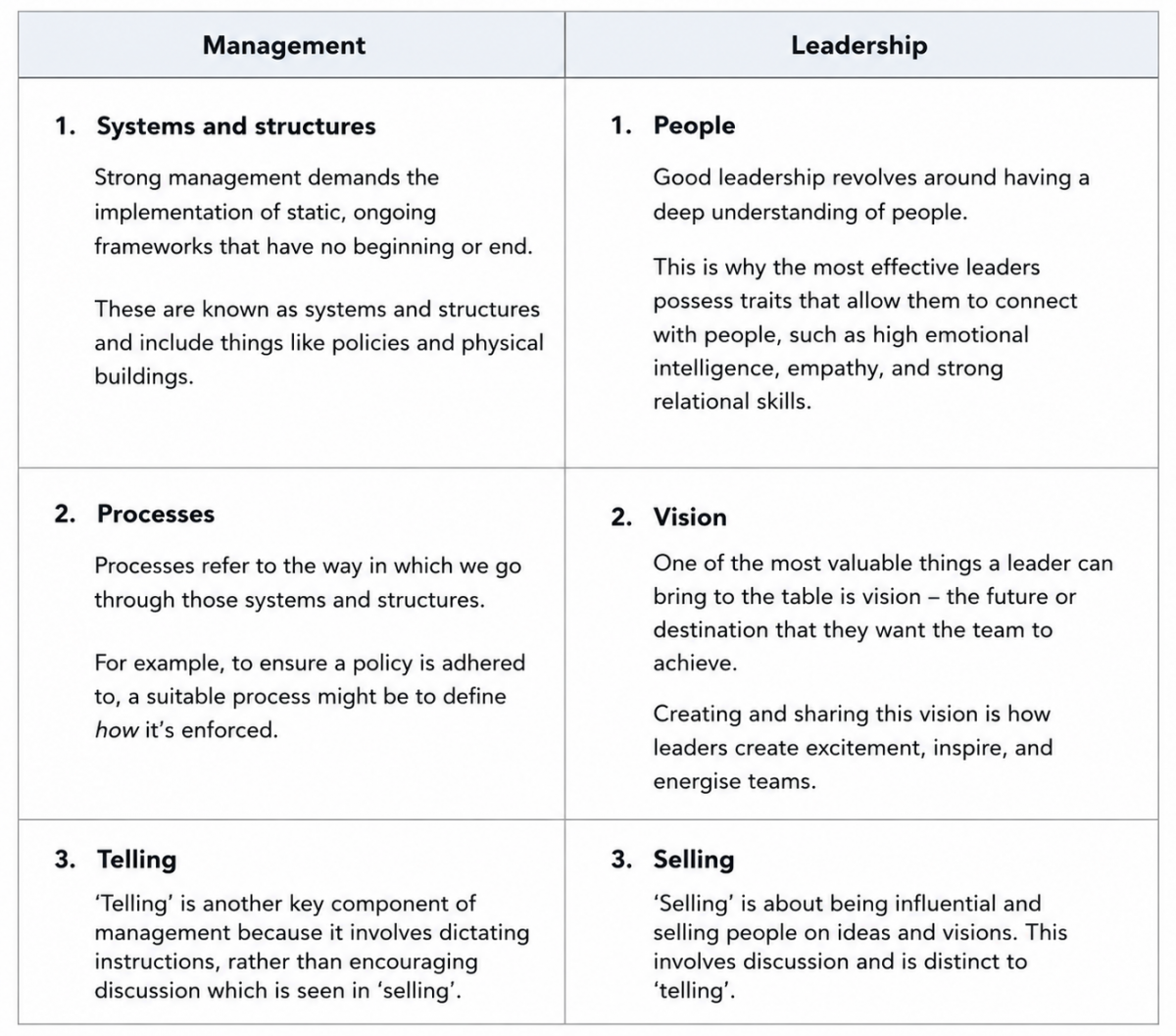
what's the difference between leadership and management

Understanding management and leadership differences: School analogy

To get a clearer understanding of what management and leadership looks like in practice, consider how a school operates.

Within practically every school, there’s defined management in the form of:

  1. Systems and structures

These systems and structures refer to the policies, timetables, and the physical environment of the building itself. This ensures there’s a designated place for the learning to take place, as well as set rules and a schedule that both teachers and children can follow.

  1. Processes

In a school, processes cover aspects such as the way lessons are delivered, the length of lessons, and any behavioural management that takes place. These easy-to-follow processes provide teachers with greater direction, helping them to smoothly navigate the school’s broader systems and structures.

  1. Telling

Due to the natural hierarchy of authority in a school, there’s a natural level of ‘telling’ that teachers and other authorities must do to ensure the safety of students. This might include telling them what they need to do in the event of a fire drill, injury, or any other kind of incident.

Schools also tend to have leadership teams who shape what the school becomes rather than ensure compliance.

These leaders play a pivotal role in three key ways:

  1. People

Headteachers and other individuals in senior leadership positions are most effective when they understand that teachers and students are individuals, with their own personalities, strengths, weaknesses, and motivations.

By connecting with each person as an individual, they can provide the appropriate encouragement, structure, and support. This contributes to creating a safer, more productive, and welcoming environment for everyone.

  1. Vision

Another key role for school leadership teams is to determine what kind of school they’re trying to build – from the academic objectives and social culture to the desired prospects of students that leave the school.

For example, a school might have a mission to increase exam results, foster greater creativity, or put student wellbeing first. Vision goes much further than simple day-to-day operations which are shaped by management-related systems and processes.

  1. Selling

To really energise, excite, and inspire their students and staff, school leaders need to be able to clearly explain why the direction they want to move in matters.

Whether they want to try a new teaching method or encourage students to adopt the school’s values, they need to help people actively buy into their ideas and vision, rather than simply telling them and trying to enforce compliance.

The key takeaway? Good management in a school ensures efficiency, compliance, and organisation during the organisation’s day-to-day running. Strong leadership, on the other hand, focuses on influencing people to move the school forward in a predetermined direction.

Which is more important: leadership or management?

There’s no winner here – both management and leadership are hugely important because:

  • With management and no leadership, the organisation can feel soulless, and lacking in energy, excitement, and future vision.
  • With all leadership and no management, you might find that everyone gets on well, but nothing gets done because there are no vital systems, structures, and processes in place.

However, during the late 1900’s there was a significant spike in business management courses in the UK.

In fact, according to ResearchGate, the number of students taking business and management degrees increased more than any other subject area during the 1980s and 1990s, which means during the past 50 or so years, we’ve gotten pretty good at management.

Leadership, on the other hand, has only really been spoken about and explored to the same degree more recently.

And during this time, the narrative has shifted substantially – from leadership being about just one game-changing person coming into the organisation to more about how leaders interact with people, how they sell their vision, and how they can help an organisation to achieve its goals.

Subsequently, leadership is the newer and lesser-known skill.

This often means that individuals in these positions are more au fait with management than they are leadership, resulting in organisations that function well day-to-day, but lack direction, energy, and momentum.

Alternatively, if you’re already a high-performing executive, leadership coaching can help you to reach the next level and realise your true potential.

Speak to us today about specialist leadership coaching

At the Drew Povey Consultancy, we’re committed to helping companies and individuals succeed with tailored leadership coaching – either on a 1:1, team, or keynote delivery basis.

We’ll take the time to understand your requirements and recommend the most suitable solution. To find out more about our bespoke leadership coaching services, please don’t hesitate to contact our team today.

After filling in the form, we’ll reach out shortly to learn more about how we can help.

Why communication is crucial in leadership

We’re often taught that communication is a ‘basic’ skill.

Unfortunately, ‘basic’ can be synonymous with both simplicity and importance, which is where the confusion arises.

Because when we start to see communication as just a simple skill, we assume that it’s something everyone can do, but this isn’t the case.

If that were true, we wouldn’t see so many conversations ending in individuals and entire teams feeling confused, disconnected, or unclear about what’s been said.

Communication is complex and especially crucial in leadership because at its core, communication in leadership drives three things: clarity, trust, and culture.

And those three elements shape performance.

Why is communication important in leadership?

Fortunately, the importance of communication in leadership is straightforward.

When communication is working smoothly and efficiently, people can move forward faster. But when it doesn’t, performance starts to slow down, or in some cases, break apart completely.

Often, the issue isn’t a lack of communication, it’s the understanding of what communication actually is.

What exactly is (and isn’t) communication for a leader?

Communication is not information

One of the biggest errors that leaders make is believing that once they’ve said something, they’ve effectively communicated with their team.

However, communication is not just what we say, it’s how we say it (typically using non-verbal actions such as eye contact, smiling, hand gestures) and what others will understand because of how it’s been said.

In fact, Albert Mehrabian’s research suggests that 93% of emotional communication is non-verbal, highlighting the importance of tone and body language in leadership communication.

When leaders focus on sending information rather than actively creating clarity – through their tone, eye contact, and other non-verbal actions – that’s where gaps in communication start to appear.

And in those gaps, confusion will grow, assumptions creep in, and ultimately performance goes the wrong way.

A simple test: if your message needs explaining afterwards, then it was probably information rather than communication.

Communication is about listening more than talking

Listening is also a key part of communication.

While it’s often treated as soft skill or ‘nice to have’, it’s the most important part and should be the fundamental starting point for every leader.

Because if leaders aren’t listening, then they don’t know how their message will land, what’s going on beneath the surface, or how people are really feeling.

Ultimately, they’re guessing what people need, making decisions in the dark, and losing perspective.

Subsequently, their team won’t feel heard and is more likely to disengage, feeding the low levels of employee engagement currently plaguing the USA, UK, and other European countries, including Spain, France, and Italy.

In fact, according to Gallup’s 2023 State of the Global Workplace Report, a significant 90% of UK employees are disengaged, with 69% of American and Canadian employees also reporting disengagement in the form of either quiet or loud quitting – directly impacting performance and productivity.

While disengagement is complex, one thing is clear: when people don’t feel heard, they stop fully showing up – making listening a core leader responsibility.

Communication puts connection first

An idea from the American author and leadership orator, John Maxwell – another effective way to think about communication is to look at it like making a phone call.

You might have the perfect message, but if the signal is poor or the person on the other end of the line doesn’t pick up, then it’s never going to land. We see it time and time again – leaders jump straight into delivering a message without first getting, and maintaining, that connection.

Without that ongoing trust and rapport, even the best messages can fall flat. And when messages don’t land, trust starts to erode. As a leader, this means focusing on connecting first before relaying your message.

Communication is a process

Communication is also a gradual process, but many leaders move too quickly and start to lose people along the way.

The best leaders don’t do that – they’re happy to revisit things with people or to reclarify or reshape a message until they get it to ‘hit-and-stick’ – rugby terminology for when the tackler makes contact (the hit) and keeps hold of them (the stick).

Good communication is therefore conveying information until it’s memorable and firmly established. This demands that leaders check in, ask questions, invite challenge, and create space for others to come back to them and let them know what they think and feel, because clarity isn’t achieved in a moment.

When communication is rushed, misunderstandings turn into bigger problems over time and that’s where problems with trust and team culture start to come to the surface.

Communication closes the loop

Communication isn’t complete when its spoken, it’s complete when it’s understood.

Between timing, tone, body language, context, and assumptions, there’s so much going on all at once that it’s easy for misunderstanding to creep in – and in many cases, it’s probably inevitable.

Leaders will often spend six months thinking about something, then tell their team about it in just six minutes and assume everyone will understand.

But while the leader’s done all the heavy lifting, skipping key stages of the thought process can result in people being left behind.

Closing the loop by making room for clarity and togetherness goes a long way to supporting more comprehensive understanding.

Where to start

Communication is one of (if not the most!) powerful tools a leader can have, but it’s also one of the most misunderstood and complex.

Unsure where to start? The three most effective mental shifts a leader can make when it comes to thinking about communication is to move from:

  • Talking → listening
  • Informing → connecting
  • Sending → shaping

Because the best leaders don’t deliver messages, they create understanding.

And when you have understanding, you have clarity, trust, and culture – the key drivers of truly exceptional performance.

Expert leadership guidance when you need it

For tailored leadership coaching on a variety of topics, including effective communication, please feel free to contact the Drew Povey Consultancy today.

Once you’ve filled in the enquiry form, we’ll be in touch in shortly to discuss your specific requirements and find out how we can best support you and your team.

Why high-performing executives still need a leadership coach

Convinced that it’s only the elite C-suiters with declining performance that require guidance from a leadership coach? This couldn’t be further from the truth.

Even high-performing executives stand to benefit from tailored professional mentoring, but what is leadership coaching and how is it beneficial exactly?

What is leadership coaching?

Leadership coaching is about providing individuals in management positions (including CEOs, founders, senior managers, and executives) with the necessary guidance, advice, and skills to successfully lead their teams.

Crucially, leadership coaching is for everyone who performs a leadership role within a business – not just those at the top of the organisational hierarchy.

Another common misconception about leadership coaching is that it’s only helpful for those struggling with their performance.

However, it’s actually a far more effective tool for those at the height of their career.

Who’s considered a ‘high-performing executive’?

If your role revolves around strategy, leadership, driving business results, and aligning teams around a shared vision, and you often report to the CEO or Board of Directors, then you’re likely a high-performing executive.

This title can be attributed to a wide range of roles, including C-suite positions such as Chief Operating Officer, Chief Financial Officer, and Chief Revenue Officer, as well as non-C-suite roles, including Managing Director and Executive Vice President.

Why is coaching important in leadership?

A leadership coach – with the right knowledge, experience, and expert insight – can assist high-performing executives with:

Identifying blind spots

With great success comes…blind spots.

Often, as individuals move higher up in a business, there are fewer people around them who are willing to provide their honest, unfiltered feedback.

In fact, a report from the Trades Union Congress found that one in three workers feel uncomfortable approaching their managers about problems at work, while a Glassdoor poll revealed that nearly half of UK employees have lied at work.

Whether these actions and emotions are driven by a lack of psychological safety, fear of repercussions, or distrust in leadership, this naturally creates blind spots.

Afterall, you can’t see the label from inside the jar.

Even if colleagues are willing to provide honest feedback, it’s important to remember they’re inside the jar with you.

A leadership coach, on the other hand, offers an external viewpoint, holding up an unfiltered mirror that provides executives with a different perspective.

In this way, leadership coaching gives high-performing executives the opportunity to think, consider, and identify not just areas of weakness, but also hidden areas of untapped success.

Pushing performance past the plateau

It’s common for high performers to focus all their attention on stabilising the business when they first move into leadership positions. While this is a tried-and-true method for keeping the boat steady, sticking with stabilisation can lead to something less desirable – stagnation.

It’s during this performance plateau that leadership coaching can be most valuable by introducing deliberate disruption. Designed to incorporate challenge, stretch, and discomfort, a leadership coach can help executives to not just maintain their current performance, but to reach the next level.

Consider an elite athlete, for example, when they’re performing well – do they train harder? No, they train differently and look for marginal gains. Leadership coaching can ensure executive performance pushes past the plateau and extends into new areas of opportunity.

Encouraging self-reflection

Generally, the more responsibility an individual takes on within an organisation, the busier they become which has a direct impact on the amount of time they can dedicate to thinking – one of the main things they’re actually being paid to do.

The result? Rather than bringing value to the business in the form of strategic leadership, they get bogged down in operational bottlenecks, high stress, and a barrage of low-value, day-to-day firefighting tasks that fail to move the business forward.

Leadership coaching affords high-performing executives with the chance to pause, get perspective, and see where their priorities really should lie. Without this reflection, their performance runs the risk of becoming reactive rather than intentional.

Enhancing existing leadership attributes

Often, individuals that work their way into executive positions already possess great leadership attributes.

That’s why the job of a leadership coach isn’t to show them how to lead, but help them to avoid becoming trapped in ‘the way they’ve always led’.

Some of the most successful, high-performing executives are those who can move away from the rigidity of long-held habits and methods, embracing change rather than rallying against it simply because they’ve ‘always done it another way’.

Because even the things that initially made you successful can, over time, quietly make you obsolete. As Albert Einstein reportedly said, “Insanity is doing the same thing over and over again and expecting different results”.

Leadership coaching is therefore designed to support the evolution of how leaders work, helping them to take advantage of changes (such as Artificial Intelligence) and prevent them from repeating the same patterns again and again.

Improving emotional intelligence

According to research from TalentSmartEQ, 90% of top performers have high emotional intelligence.

While this attribute may not seem like a defining leadership quality, emotional intelligence in a leader often results in enhanced team trust, more empathetic professional relationships, and improved workplace cultures.

Leadership coaching plays a pivotal role in boosting this intelligence through fostering self-awareness with honest and constructive feedback and helping executives to regulate their own emotions through stress management techniques and mindset work.

Navigating career transitions

Moving from one position to another (even within the same organisation) isn’t always a seamless process – especially if you’re taking on more leadership responsibilities than before.

While your performance may be exceptional as a Head of Department, moving into an executive role brings with it the challenge of shifting your mindset from ‘doing’ to ‘thinking’.

A leadership coach can help you to navigate this career transition more smoothly by reframing your identity into a strategic leader and helping you to understand your core values as well as your existing strengths and weaknesses through comprehensive feedback.

Combating isolation as a leader

Regardless of where you sit within an organisational hierarchy, being a leader can lead to deep feelings of isolation and heavy responsibility.

This is supported by the findings of a YouGov survey which was carried out on behalf of The Start Up Loans Company. This research found that 44% of smaller business owners in the UK experienced loneliness or isolation while running their business.

Interestingly, 37% of medium-sized business leaders also reported feelings of isolation, highlighting just how segregated individuals in these positions can feel regardless of the size of the organisation.

A leadership coach offers high-performing executives a confidential, safe space to express their concerns, fears, and complex business decisions without fear of political repercussions from other members of the business.

Coaching also supports leaders with identifying their own emotions and self-regulating, helping to combat feelings of ‘imposter syndrome’ and relieve self-inflicted pressure.

Driving organisational performance

As always, the bottom line remains key for all businesses.

And while leadership coaching may not seem like the most direct route to driving organisational performance, the fostering of self-reflecting, adaptable, and emotionally intelligent leadership often creates a ripple effect that has a positive impact on the entire team.

In short, highly-skilled, well-equipped leaders are instrumental in fostering a trusting, respectful, and resilient workforce, allowing their team to do what they do best while they focus on vision and strategy.

Why high-performing individuals can always benefit from further training and development

At the Drew Povey Consultancy, we find one of the easiest ways to explain why high-performing executives should still invest in leadership coaching is by comparing them to elite athletes.

We call this the ‘corporate athlete mindset’.

In the same way that the very best athletes demand a coach to support them with acquiring rest, feedback, and reflection, feedback, development, and conditioning (in the form of skills and mental training), top executives require a similar level of coaching to maintain or improve their performance.

Crucially, it’s important to remember that enlisting help from a professional leadership coach isn’t a sign that you’re falling behind. Let’s face it, if you were really struggling, you’d be speaking to the HR department.

Instead, seeking out leadership coaching as a high-performing executive is a sign of wisdom and strength, used strategically to ensure that you don’t fall behind in the first place.

Professional leadership coaching for high-performing executives

With more than twenty years of experience working in elite level sport, education, and business, Drew Povey leverages his in-depth knowledge across these areas to support the performance of executives with unique leadership coaching programmes.

To create these tailored programmes, the Drew Povey Consultancy draws on business psychology and bespoke techniques, incorporating a wide range of elements in line with the executive’s specific development requirements.

Whether you’re eager to learn more about these highly effective leadership support models or have a related question about self-development, please don’t hesitate to get in touch today.

Simply fill in the online contact form and we’ll reach out shortly to find out more about how the Drew Povey Consultancy can help.

What does good leadership look like in the age of AI?

There’s no question that the definition of ‘good leadership’ has evolved dramatically over time.

Driven by the latest leadership theories, economic changes, societal shifts, and even rapid technological developments, our understanding of what makes a great leader has remained fluid.

Once, it was believed that control, authority, and rigid hierarchy were key ingredients for strong leadership. More recently, collaboration, emotional intelligence, and adaptability have played a greater role.

Now, in an increasingly AI-driven world, how might our perception of great leadership continue to change?

With over twenty years of experience in elite level sport, education, and business, Drew Povey answers this question, outlining how team managers and CEOs alike can adjust their skillset to stay relevant and effective in the age of AI.

Moving from control to connection

A good leader was previously thought of as someone who dictated every move and handled every process.

With AI technology now excelling in efficiency and automation, it can do all the heavy lifting when it comes to optimising workflows and carrying out execution at scale.

But there’s still room for modern leaders to flex their managerial muscles. Instead of simply managing systems, today’s leaders should turn their attention to driving team direction, meaning, and human connection.

By creating purpose, cultivating trust, and inspiring a shared vision, the most effective leaders will be those who can help people see how their work contributes to the bigger picture.

In essence, good leadership amid the rise of AI is far less about command and control, and more about coach and connect.

Leveraging the power of emotional intelligence

As AI makes light work of logic-based tasks, emotional intelligence will become the key differentiator. Because empathy, awareness, and emotional agility can’t be automated or replicated.

Even attempts at prompting AI to take an empathetic approach feel disingenuous and hollow. Let’s consider a situation where a leader must make redundancies:

An automated, AI-generated email sent to the affected individuals would certainly be efficient and clear, but would this be the most compassionate, understanding, and respectful approach? Hardly.

The best leaders? They’ll be the ones who use tech for insight, but emotional intelligence for determining impact and sensitivity.

Focusing on upskilling and human growth

Autonomous tools are taking more and more routine tasks off leaders’ plates. But by doing so, they create sought-after space.

And the way in which leaders fill this space is where they can demonstrate their true value. One such activity involves driving team development.

By encouraging learning, curiosity, and cross-functional skills, they can turn freed-up time into future value, supporting greater capability, confidence, and creativity across their team.

Multiplying creativity

With automation removing time-consuming repetition, creativity becomes an increasingly valuable currency. And if leaders want to create an environment that fosters creativity and innovation, they must champion experimentation and psychological safety.

This means rewarding curiosity, treating setbacks as feedback rather than failure, and allowing ideas the time and space they need to fully develop.

The leaders who recognise this distinct shift and are able to respond accordingly will turn automation into amplification, multiplying the uniquely human, creative potential of their people.

Offering purpose as the north star

AI will follow instructions flawlessly (or at least most of the time, with the right prompting) but it can’t choose the best direction. That’s where good leadership comes in.

Leaders act as the compass, defining the ‘why’ (the purpose, principles, and perspective) behind a certain move or decision.

By leveraging AI to augment human judgement, rather than replace it entirely, these leaders will ensure technology serves people, not the other way around.

A crucial leadership skill now will be integrating machine intelligence with human wisdom, knowing when to listen to the algorithm and when to trust intuition.

The new leadership equation: AI + HI (Human Intelligence)

Since the advent of the science-fiction genre, there’s been endless literature that fans the flames of AI versus humanity.

But the conversation about the future is far too focused on who will win the war between artificial and human intelligence – rather than who will master how to combine them.

The leaders who will thrive in this new era will be those who can balance technological capability with timeless human character.

They’ll understand how to harness the precision, speed, and scale of AI while grounding decisions in empathy, ethics, and emotional intelligence.

How to tackle burnout and disengagement as a leader

Feeling exhausted and overwhelmed with your professional position as a leader?

Between inspiring entire teams, making business-critical decisions, and setting a clear vision for the company, leadership burnout coupled with disengagement is reportedly widespread – and on the rise.

According to figures from DDI’s Global Leadership Forecast 2025, which surveyed over 10,000 leaders from different industries across the world, 71% reported significantly higher stress levels since stepping into their current roles.

Add to this the findings from Kahoot’s 2025 Workplace Engagement Report – where only 47% of leaders currently consider themselves “fully engaged” in their work, and 46% say they would give up their title if it meant regaining a sense of engagement – taking up a leadership position starts to look like a rather unattractive proposition.

These staggering – and deeply revealing – statistics highlight the importance of developing workplace resilience and implementing methods of safeguarding your professional performance.

As an influential leadership authority operating in the elite level sport, education, and business space,
Drew Povey explains his new playbook for re-energising yourself and your teams.

Why does it matter when the leaders lose their spark?

Burnout and disengagement are connected, but they are not the same.

While burnout is exhaustion, often driven by constant pressure and decision fatigue, disengagement is detachment fuelled by a loss of connection, purpose, and enthusiasm for the vision that once motivated every decision.

Of course, feeling disengaged and burnt-out at the same time can have a profound impact on your individual professional output as well as your personal life. But when leaders lose their spark, teams lose their light, too.

Instead of being confined to the performance of just one member of the team, the effects of burnout radiate across teams, and in some cases, entire businesses as they quietly drain energy, creativity, and culture from the inside out.

It’s the leadership paradox of our time: the more responsibility we carry, the less space we create for our own renewal.

The remedy? Crucially, it’s not about working harder. It’s about leading differently.

The five leadership levers to reignite engagement

Recharge yourself first

The oxygen mask principle applies – if you can’t breathe, you can’t lead.

Building rest periods, moments of reflection, and firm boundaries into your routine isn’t self-indulgence; it’s self-preservation that will ultimately support the entire team’s success.

Reconnect people with purpose

Engagement thrives when people know why they do what they do. Clarity, context, and connection are leadership fuel.

Great leaders, particularly in the age of AI and automation, don’t just tell people what to do, they offer meaning behind the tasks, reminding the whole team why their work really matters.

Reignite growth and learning

Disengagement often comes from stagnation. When work stops stretching us, it starts draining us.

By creating space for curiosity, learning, and development, both for your team and for yourself, you can promote performance-boosting growth and learning.

Lead with emotional intelligence

Empathy, active listening, and psychological safety are no longer optional soft skills that, under the right circumstances, are ‘nice to have’.

All these skills are indicative of a leader with strong emotional intelligence. And these individuals are adept at creating teams that feel seen, supported, and safe enough to bring their best to the table.

Celebrate progress, not just perfection

Recognition is the antidote to disengagement. The smallest “I saw that” or “well done” moment can reignite motivation more than any grand strategy. When people feel valued, they bring value.

Focusing on presence, not performance

Burnout and disengagement are stark reminders that leadership, at its core, is incredibly emotional, energetic, and deeply personal.

Yes, the data tells a worrying story right now, but it also reveals an opportunity: an opportunity for leadership to shift away from performance obsession and towards presence intention.

With speed, scale, and stress dominating the workplace, the most effective leaders will be those who can listen deeply, think clearly, and act intentionally amid pressure.

By adopting a more aware, empathetic, and human approach to leadership, we create space to look inward and ask:

“Am I still connected to what makes me come alive?”

Because when leaders rediscover that spark, everyone else can feel the warmth.

The Quiet Power: How Character Becomes the Hidden Engine of Great Leadership

When we think about great leaders, we often focus on their skills: their ability to strategise, to execute, to manage complex situations.

And it’s true that competence is important, but it’s not the whole story. From Julius Caesar to Winston Churchill, great leaders are distinguished not by what they know, but who they are.

Which is where character comes into play. The quiet power behind lasting influence, the character of a leader shapes vital decisions, builds trust, and sets the tone for entire organisations.

In the modern world where skills can be quickly taught and picked up and technical knowledge can be accessed easily online or through AI, character is becoming the ultimate differentiator.

As an influential leadership authority in elite level sport, education, and business, Drew Povey outlines his view on why character is the hidden engine of great leadership.

Beyond Knowledge: Why Who You Are Outweighs What You Know

Whether you learn most effectively through group courses, independent research, or one-to-one coaching, knowledge is abundant and can be acquired at speed.

While there’s no doubt that knowledge will get you a seat at the table, character determines how long you’ll be there for and whether people want to sit there with you.

Why? Because knowledge can always be gained, but character (while it can be taught with time and effort), is ingrained into a person. Character can’t be Googled, outsourced, or picked up in a matter of minutes.

It’s the foundation of how a leader shows up: how they act under pressure, how they handle power, and how they balance personal ambition with the good of the team.

When times are uncertain, people don’t just follow the most knowledgeable leader. They follow the one whose integrity is steady, whose values are clear, and whose actions are consistent.

Character First: The Leadership Filter We Keep Ignoring

Too often, competence is the most scrutinised element during an interview for a leadership role. Recruiters typically focus on the applicant’s years of experience, qualifications, and accreditations, commonly overlooking character.

However, the way a leader handles setbacks, communicates under pressure, and makes decisions when no one is watching reveals far more than a polished CV ever could.

As reported by Harvard Business Review, this is supported by the results of a study by the global consulting firm, KRW International which found that CEOs whose employees gave them high marks for character had an average return on assets (ROA) of 9.35% over a two-year period.

In contrast, those with low character ratings had an average ROA of just 1.93% – that’s nearly five times less than those with higher perceived character.

The conclusion – a leader’s character can directly impact business performance and the company’s bottom line, so why are we so quick to overlook character in favour of competence?

When looking at recruitment to fill a leadership vacancy, a more balanced approach that assesses both character and competence can help to ensure the position is filled by someone who’s not only capable, but also trustworthy and resilient.

The Unseen Advantage: Why Character Shapes Decisions, Teams and Trust

Character is the prime mover for everything that a leader does, quietly driving their decisions, priorities, and how they treat people – especially when things go wrong.

A leader’s character acts as a multiplier. When it’s strong, it amplifies trust, cohesion, and long-term performance. Conversely, when it’s weak, it erodes confidence and undermines results, no matter how competent the leader may be.

This line of thinking is supported by Max H. Bazerman, Jesse Isidor Straus Professor of Business Administration at Harvard Business School, and his work on ethical leadership:

“Leaders can do far more than just make their own behavior more ethical. Because they are responsible for the decisions of others as well as their own, they can dramatically multiply the amount of good they do by encouraging others to be better.

“As a leader, think about how you can influence your colleagues with the norms you set and the decision-making environment you create.”

Teams pick up on character instinctively. They notice whether their leader acts with integrity, fairness, and consistency and they respond accordingly. The result is often greater loyalty, higher levels of discretionary effort, and a deeper collective commitment to success.

In that sense, character is no longer a “soft” quality, it’s a strategic advantage that supports sustained success.

The Hardest Skill to Teach: Why Leaders Win or Lose on Character

Skills can be taught. Competence can be developed through training and experience. But character? That’s significantly harder, but not impossible, to cultivate.

According to the Harvard Business Insight ‘The Case for Leadership Character’, various learning methods, including feedback, coaching, practice, and modelling, can help leaders to enhance their authenticity, integrity, courage – all key attributes of character.

However, this process demands self-awareness, reflection, and a willingness to be shaped by challenge and failure. Leaders that successfully undergo this process set themselves apart from the crowd.

Ultimately, time and time again, it’s character that determines whether leaders merely survive in an organisation or inspire and endure.

Empathetic Leadership: Turning Kindness into a Competitive Advantage

Business is ultimately about people – and people tend to act on emotions. Strong relationships, whether with employees, customers, or partners, are built not just on logic or transactions, but on how we make others feel.

That’s why empathy isn’t just a “soft skill” or a nice-to-have – it’s a vital strategic advantage, especially in more competitive environments. Leaders who can understand, connect, and respond with kindness create stronger teams, deeper loyalty, and sustained success.

Or at least that’s what Drew Povey, an influential leadership authority specialising in elite level sport, education and business, believes. And he’s not alone.

According to a Deloitte LLP 2021 study on the ‘Global Ways of Working’, 97% of respondents reported that effective managers must have and demonstrate empathy – a stark contrast to the 45% of respondents that said their manager was able to demonstrate empathy in the workplace.

Whether you’re new to leadership or several decades deep into a senior management position, Povey explains how learning how to leverage kindness can become one of the most important tools in your leadership arsenal.

1. The Empathy Dividend

Looking to boost client retention, staff productivity, or even team innovation? Kindness in leadership pays off across all these areas.

In fact, according to the results of a Catalyst survey of nearly 900 US employees, empathy was “an important driver of employee outcomes such as innovation, engagement, and inclusion – especially in times of crisis or rapid change.”

While inclusion may not directly result in improved business performance, it can help to combat high staff turnover rates, passing on recruitment cost savings and fostering more a stable working environment for the whole team.

Gallup researchers also identified key differences in business outcomes between the most and least engaged teams, citing differences of 18% in productivity (sales), 23% in profitability, and a substantial 81% in absenteeism.

By directly linking empathy to business performance, emotional intelligence becomes an undeniable commercial advantage.

2. Triple Bottom Line, Human First

You’re (hopefully) very familiar with the concept of a bottom line as a leader – but what about a triple bottom line? And, crucially, how every aspect of this triple bottom line is rooted in empathy and human connection.

Investment of Choice

As the traditional bottom line, being the investment of choice is primarily about financial health. That’s balance sheets, turnover, profit. But investors are interested in more than just your finances – they want to know about your values and culture.

Is your business built to last? What does your culture stand for? Empathetic leadership offers a strong answer to those questions. By fostering trust, resilience, and a values-driven culture, it signals long-term stability, which is something that investors not only recognise, but reward.

Employer of Choice

People want to work with and for leaders who see them as more than just resources. When leaders act with empathy and recognise the person behind the work, they encourage employees to stay and thrive by boosting staff engagement, belonging, and loyalty.

In turn, the business also benefits from higher employee satisfaction and lower staff turnover rates – it’s a win-win!

Provider of Choice

Who do customers choose to buy from? Spoiler: not the brands that treat them like transactions.

Customers gravitate toward businesses that understand their needs, values, and aspirations. Empathetic leaders see customers as people, building genuine, long-lasting relationships rooted in understanding.

When we frame leadership through this triple bottom line, empathy becomes the common thread, transforming leaders into trusted partners for investors, sought-after employers for new talent, and preferred providers for customers.

3. From Command to Connection

Gone are the days of the old-school ‘do as I say’ directive leadership. While issuing orders, enforcing hierarchy, and streamlining decisions may have worked in the industrial era, that directive style is frankly outdated and ineffective in today’s workplace.

Modern leadership is relational and empathetic. Instead of chasing efficiency through control and compliance, empathetic leaders fuel innovation, collaboration, and adaptability. By prioritizing connection over command, they build trust and make people feel genuinely valued.

The result? Discretionary effort – that’s the creativity, energy, and commitment employees willingly give when they’re inspired, not forced. Command might deliver compliance in the short term, but connection delivers performance, loyalty, and growth that last.

4. Empathy: The Glue of Culture

“Culture eats strategy for breakfast.” While often misattributed to the Austrian-born American management consultant, Peter Drucker, the core message of how a flawed culture can undermine even the best strategy rings true.

A company might have the perfect strategy on paper, but if its culture is misaligned and undermines productivity, engagement, and loyalty, the execution of this plan will suffer.

This is where empathy becomes essential. Empathetic leaders, leaders who listen, understand, and respond, create the trust and psychological safety that holds culture together.

The result is resilient teams, stronger collaboration, and a culture that doesn’t just support the strategy but amplifies it tenfold.

5. The Hard Edge of Soft Skills

It’s a common misconception that empathy is a “soft” skill. Many people mistakenly believe that empathy may be nice to have, but it’s not vital for performance and it certainly isn’t necessary for leaders.

In reality, empathy is anything but soft. It’s a hard-earned discipline that requires awareness, consistency, and courage.

It means listening deeply, making fair and balanced decisions, and fostering psychological safety so people feel free to contribute their best ideas. These aren’t passive behaviours that some people are simply born with, they’re active, intentional practices that take effort and skill.

Practices that produce impressive results – per Volume 10 of the Annual Review of Organizational Psychology and Organizational Behavior, 2023, employees with a high level of psychological safety at work are more likely to engage in helping behaviours and to seek feedback from their peers.

As the American writer Tom Peters says, “it’s the soft skills that get the hard results” and empathetic leadership proves, beyond a doubt, that kindness is in fact not a weakness, but a competitive advantage that delivers tangible results.

Why a fear of saying ‘No’ signals leadership failure

Stuck in a cycle of saying ‘yes’? You’re not alone.

As a leader, fearing saying ‘no’ can stem from the desire to be liked, an eagerness to avoid conflict, or simply being raised in a culture that equates compliance with cooperation.

Inclusive and empowering, saying ‘yes’ as a leader feels good in the moment, keeping people happy and encouraging action. In practice, however, indiscriminately giving the go-ahead often demonstrates a lack of clarity, courage, and control.

Drew Povey, an influential leadership authority who works across sport, education, and business, shines a light on why being scared of saying no is a red flag for leaders and how strong leadership means overcoming that fear.

Getting stuck in the hero trap

Too many leaders think that good leadership is all about saving and rescuing people. Being able to ‘save the day’ and fix every problem may feel helpful and supportive, but this often isn’t the case.

Known as ‘the hero trap’, this approach to leadership can fuel group dependence when what we really want to create is an environment of confidence, development, and independence.

Saying ‘no’, when it’s right to, can stop leaders from becoming overwhelmed and overstretched (essentially stopping them from getting lost in the weeds), and empower other members of the team to step up and grow.

In this case, leadership is less about saving the day, and more about enabling growth.

The empowerment equation: Letting others say yes

Closely linked to avoiding the hero trap is the empowerment equation which works a little something like this:
When a leader says ‘no’, they create the opportunity for someone else to say ‘yes’.

Instead of ‘no’ being a rejection or disengagement, it can actually be a powerful way to encourage responsibility, giving others the opportunity to take initiative, make mistakes, and build confidence and capability.

Every time a leader steps in to fix, solve, or accommodate, they may unknowingly and unintentionally be taking away someone else’s chance to develop personally and professionally.

When done with intention and clarity, ‘no’ can signal trust and create room for other team members to flourish. Sometimes, the most empowering thing a leader can do is simply step aside.

They don’t know how to say ‘no’, so they avoid it entirely

Many leaders struggle with saying ‘no’ and it’s not because they lack authority, but because they lack strategy. By mistakenly believing that ‘no’ must be blunt, negative, or final, they either avoid saying it completely or deliver it poorly, resulting in confusion, resentment, or guilt.

Instead, great leaders know how to communicate with clarity, respect, and context. In place of an outright ‘no’, they say things like:

  • “Not right now, because…”
  • “This is a good idea, just not the right fit for our team with our existing goals”
  • “I appreciate the suggestion, but we just don’t have the capacity for this at this stage…”

With a thoughtful and respectful explanation, the ‘no’ becomes less about rejection and more about transparency and understanding – something that teams value far more than vague indecision, broken promises, or unclear expectations.

In leadership, avoiding ‘no’ doesn’t prevent conflict, it merely delays it.

The cost of avoiding ‘no’ shows up in your calendar

All effective leaders should start the week by asking themselves the simple and revealing question: ‘Does my diary reflect my true priorities?’

Because if you’re saying ‘yes’ too often (to meetings, requests, and distractions), you’ll be left with a calendar that’s packed with misaligned tasks, draining conversations, and low-leverage commitments – all at the expense of your own priorities.

Reclaiming control of your calendar begins with having the discipline to decline, delegate, and defer. With these clear boundaries in place, you can prevent your diary from slowly filling up with other people’s priorities instead of your own.

Your time is your most valuable resource – saying ‘no’ can help you to protect it accordingly.

Choosing comfort over courage

As highlighted by an EMBO report titled “The power of saying no”:

“It takes courage to say no, but it maintains liberty by setting limits.”

That statement cuts to the heart of what many leaders quietly struggle with. Ultimately, saying ‘no’ is hard – we want to be liked, we fear conflict, and we want to keep the peace.

We also think that by doing things we shouldn’t, even when it’s misaligned or unsustainable, it can help us to remain relevant or needed. In reality, constantly saying yes erodes clarity, focus, and leadership integrity.

When leaders have the courage to say ‘no’, they encourage liberty within limits by staying intentional with their decisions and focusing on what matters more than people-pleasing and popularity.

As the EMBO report points out, saying no preserves liberty, not by removing freedom, but by creating the conditions in which freedom can thrive. Liberty within limits allows people to understand expectations and do their best work without confusion or burnout.

Having the courage to say no isn’t a sign of selfishness – it’s a sign of strong leadership.

The importance of dissent: How to avoid surrounding yourself with ‘Yes’ men

Surrounding yourself with ‘yes men’ – that’s people who always agree with your decisions just to maintain harmony and gain leadership approval – is a recipe for leadership failure.

When these individuals support your vision without question and only tell you what you want to hear, they don’t strengthen your leadership, they quietly undermine it.

That’s why cultivating a culture of dissent is so important.

Far from being repressed, thoughtful and respectful dissent should actually be encouraged. Essential for ensuring effective leadership, this pushback supports crucial evaluation, often resulting in better decisions, stronger teams, and greater trust.

A prominent leadership coach with significant experience working with elite athletes, educators, and businesses, Drew Povey outlines the dangers of ‘yes men’ and how cultivating a culture of dissent can help.

Combat team-killing echo chambers

When every member of a team feels pressured to agree, the team stops being able to think critically and all authenticity is lost. That’s the danger of an echo chamber: it only creates the illusion of alignment.

Some of the best leaders understand that dissent isn’t about disruption. It’s about data.

Data, in the form of valuable feedback, fresh perspectives, and new insights, helps the team to make more informed decisions. Without it, the decision-making process becomes dysfunctional – bad ideas go unchallenged, blind spots multiply, and risks are overlooked.

Over time, this doesn’t just impact outcomes, it also impacts the whole team by wearing away trust, stalling innovation, and stifling performance.

For a healthier, more productive team, leaders must create space for constructive disagreement by cultivating a safe and trusting environment.

Consider the creeping cost of hearing ‘yes’

Every ‘yes’ you hear as a leader may feel like progress, but when a team stops questioning and starts agreeing automatically, you’re no longer making smart, informed decisions. Instead, you’re just coasting on consensus.

That’s because too many yeses create blind spots. They silence the quiet concerns, skip over second thoughts, and smooth out the friction that often leads to better thinking.

And the cost? It’s rarely immediate, but always significant. Mistakes grow over time and accountability slips. Eventually, these problems can develop into more complex issues and completely trip up projects or entire businesses.

Healthy leadership doesn’t come from surrounding yourself with agreement. It comes from clarity. And clarity can be found in encouraging healthy challenge that sharpens thinking, strengthens decisions, and prevents costly missteps.

Foster the strength of true diversity

Real diversity is not just about backgrounds, it’s about perspectives. Beyond the demographics, diversity should ensure that different voices are genuinely heard, valued, and challenged in a productive way.

When teams embrace different ways of thinking, they make better decisions. That’s because disagreement, when done well, is how we stress-test ideas, uncover blind spots, and pressure-check assumptions before they become costly mistakes.

This is backed by a Cloverpop study white paper which found that diverse teams (in age, gender, ethnicity, and geographical location – and by extension, perspective) make better business decisions a whopping 87% of the time.

Ultimately, if everyone sees the world the same way, or feels they must pretend they do, then you’re not leveraging the true strength of diversity.

Conduct the leadership truth test

The most effective leaders don’t simply ask for feedback, they actively seek brutal truths – something that they’ll never get from ‘yes men’.

To uncover what’s really going on, leaders must cultivate a culture of psychological safety – where people feel safe enough to speak up, push back, admit accountability, and say what they genuinely think without fear.

Whether challenging ideas, raising concerns, or simply being honest, good leaders want to hear those hard truths. Not because they enjoy discomfort, but because they understand that clarity is more important than ego.

As McKinsey & Company’s survey highlights, when employees feel secure enough to openly share suggestions and question the status quo, organisations become more innovative, adaptive, and resilient.

Once leaders know what’s actually happening (instead of what they hope is happening!), they can respond with clarity and confidence – even if it’s uncomfortable or hard.

Use dissent as a leadership mirror

Dissent is one of the clearest reflections of a leader’s confidence. Insecure leaders tend to silence it, while the most secure leaders actively seek it out.

When dissent is offered respectfully and openly welcomed, it indicates that the team leader has built a trustworthy and psychologically safe environment. It also shows that they’re confident enough to be challenged, humble enough to listen, and wise enough to know they don’t have all the answers.

Instead of seeing dissent as a threat to their authority, strong leaders see it as a mirror for self-awareness and growth.

As a result, if no one is pushing back, questioning assumptions, or offering different perspectives, don’t assume alignment – consider whether your team feels safe enough to disagree.
Because if and how your team disagrees with you speaks volumes about your leadership style and efficacy.

Not just diversity – better leadership: Why all-female teams win

At the end of July 2025, Middlesex Football Association announced the ground-breaking moment that they made history by becoming the first completely female-led County Football Association.

This key milestone followed the appointment of Philina Toiny as Chair, who joined the CEO, Kayleigh Saunders, and President, Barbara Bivens, ensuring all the highest leadership roles were occupied by women.

Historically dominated by men, these football leadership positions are now seeing a rising influence of women, following a record 56% increase in the number of women and girls playing the sport over the past four years.

Outside of sport, the Institute of Directors also reports “near-revolutionary change” with nearly half (47%) of new board appointments to FTSE 100 companies, and more than 35% of leadership roles, being filled by women.

A respected leadership expert with a unique viewpoint, Drew Povey, shares his thoughts on the benefits of all-female leadership teams, backing his insights with compelling data from some of the most recent, reliable, and prominent studies.

1. The real edge? Collaborative and emotionally intelligent leadership.

Diversity isn’t the destination; it’s the starting point. When teams are truly inclusive, they stop mirroring one voice and start magnifying performance. This is especially true in leadership, where different perspectives don’t dilute clarity, they sharpen it.

At the heart of this is cognitive diversity and the impact it has on how decisions are made. Female leaders, for instance, often bring more collaborative and emotionally intelligent approaches to leadership – qualities that are especially valuable in high-stakes, complex environments.

These insights are supported by a 2024 study on gender and leadership styles, which found that women tend to lead in more inclusive, empathetic, and people-focused ways, ultimately benefiting team dynamics and strategic outcomes.

2. Psychological safety starts at the top.

The real question isn’t “Why can all-female teams succeed?”, it’s “Why did it take so long to give them the chance?”. Female-led teams often foster cultures of inclusion, trust, and psychological safety which are all proven ingredients of stronger performance and innovation.

Code-named Project Aristotle, Google conducted a two-year research project starting in 2012 to uncover exactly what makes teams successful. The findings revealed that success depends less on who is on the team and more on how they work together, with psychological safety emerging as one of the most important factors.

Essentially, this environment of strong psychological safety meant that team members felt safer and more confident taking risks, speaking up, and sharing ideas without fear of being viewed as ignorant, incompetent, or disruptive.

This is echoed in McKinsey’s 2024 Women in the Workplace report which highlights how women may have a greater awareness of interpersonal dynamics, specifically microaggressions – with 28% of women recognising these comments and actions compared to just 11% of men.

This heightened social awareness suggests that women leaders may be more attuned to subtle forms of bias or exclusion, making them better equipped to create inclusive, respectful environments – something that’s directly linked to improved psychological safety and team performance.

3. Leading with strength and sensitivity, not command and control.

The best leaders don’t lead with ego – they lead with purpose, empathy, and presence. And all-female teams often bring a different, more evolved style of leadership by blending strength with vulnerability and championing connection over control.

Certain leadership behaviours, such as active listening, people development, and strategic patience are therefore more common in female-led teams. These behaviours align with what research defines as transformational leadership.

As per the findings of a 1992 meta-analysis of 61 studies, female leaders demonstrate more transformational leadership styles, meaning they’re more likely to embody positive aspects of the organisation and use inspirational methods to engage their team.

This contrasts with their male counterparts who tend to favour traditional transactional leadership and prioritise ‘command-and-control’ models.

Final thoughts: When leadership evolves, performance follows.

Female leadership is a common topic for leadership consultancies, but tackling this topic isn’t about making the blanket statement that women are better leaders than men.

The push towards all-female leadership teams is undoubtedly a welcomed and well-intentioned one, seeking to address the historical exclusion of women’s skills from the leadership arena.

And while it’s true that women have been restricted by glass ceilings for far too long, the key to strong leadership is in crafting a balanced team with different views and approaches.

Because this isn’t a diversity story, it’s a high-performance one. The best leadership teams don’t look the same, think the same, or act the same. They’re built with different perspectives, experiences, and strengths, and united by a shared sense of purpose.

Ultimately, true leadership progress lies not in outright exclusion or overcorrection, but in building inclusive leadership teams where diverse talents – regardless of gender – can thrive.