

Leadership versus management: The differences explained

Two terms that are often used interchangeably – by both industry experts and the wider public – is leadership and management.

In fact, many authorities in this area, including strategy expert Jeroen Kraaijenbrink and published research in the American Journal of Pharmaceutical Education, attest that management and leadership are essentially the same thing.

While there’s certainly overlap between the two, there are several key distinctions that separate management and leadership.

By distinguishing between them, we can not only better understand when a situation would benefit more from one or the other, but also learn how we can develop these different skillsets.

What is leadership versus management?

In short, the main difference between leadership and management is leaders energise teams and set the goals, while managers put the steps in place to achieve these goals.

As 20th century pioneer, Rear Admiral Grace Murray Hopper put it: “You manage things; you lead people.”

While you can manage people to a degree – by controlling the external systems, processes, and environment around them – people will always choose how they show up internally, and leadership is what influences that choice.

What is the difference between management and leadership?

With management being more about compliance, and leadership about influence, the two often work in tandem to drive progress within an organisation.

Crucially, however, they have very separate roles.

So, what’s the difference between leadership and management? Let’s break it down into three key areas.
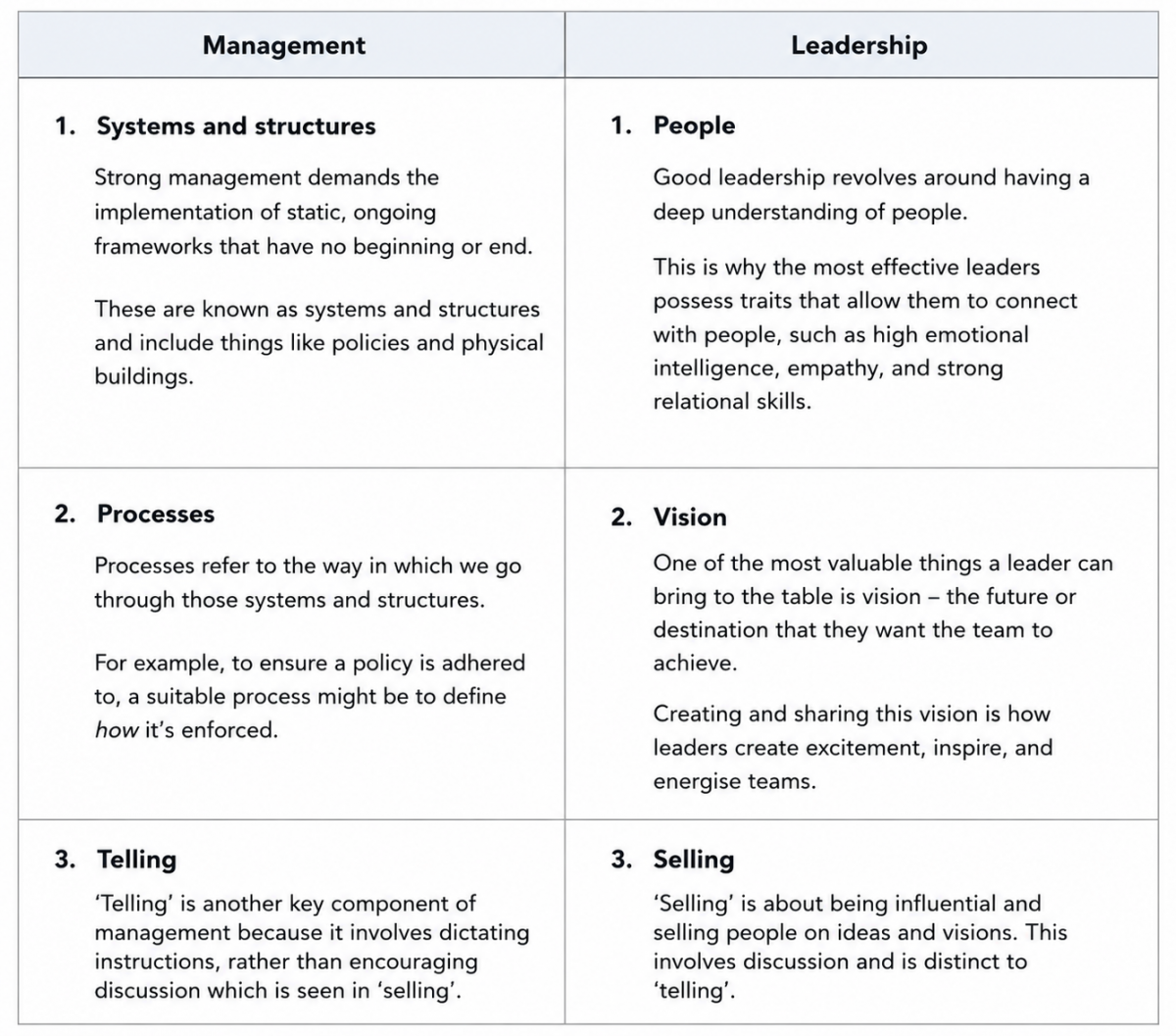
what's the difference between leadership and management

Understanding management and leadership differences: School analogy

To get a clearer understanding of what management and leadership looks like in practice, consider how a school operates.

Within practically every school, there’s defined management in the form of:

  1. Systems and structures

These systems and structures refer to the policies, timetables, and the physical environment of the building itself. This ensures there’s a designated place for the learning to take place, as well as set rules and a schedule that both teachers and children can follow.

  1. Processes

In a school, processes cover aspects such as the way lessons are delivered, the length of lessons, and any behavioural management that takes place. These easy-to-follow processes provide teachers with greater direction, helping them to smoothly navigate the school’s broader systems and structures.

  1. Telling

Due to the natural hierarchy of authority in a school, there’s a natural level of ‘telling’ that teachers and other authorities must do to ensure the safety of students. This might include telling them what they need to do in the event of a fire drill, injury, or any other kind of incident.

Schools also tend to have leadership teams who shape what the school becomes rather than ensure compliance.

These leaders play a pivotal role in three key ways:

  1. People

Headteachers and other individuals in senior leadership positions are most effective when they understand that teachers and students are individuals, with their own personalities, strengths, weaknesses, and motivations.

By connecting with each person as an individual, they can provide the appropriate encouragement, structure, and support. This contributes to creating a safer, more productive, and welcoming environment for everyone.

  1. Vision

Another key role for school leadership teams is to determine what kind of school they’re trying to build – from the academic objectives and social culture to the desired prospects of students that leave the school.

For example, a school might have a mission to increase exam results, foster greater creativity, or put student wellbeing first. Vision goes much further than simple day-to-day operations which are shaped by management-related systems and processes.

  1. Selling

To really energise, excite, and inspire their students and staff, school leaders need to be able to clearly explain why the direction they want to move in matters.

Whether they want to try a new teaching method or encourage students to adopt the school’s values, they need to help people actively buy into their ideas and vision, rather than simply telling them and trying to enforce compliance.

The key takeaway? Good management in a school ensures efficiency, compliance, and organisation during the organisation’s day-to-day running. Strong leadership, on the other hand, focuses on influencing people to move the school forward in a predetermined direction.

Which is more important: leadership or management?

There’s no winner here – both management and leadership are hugely important because:

  • With management and no leadership, the organisation can feel soulless, and lacking in energy, excitement, and future vision.
  • With all leadership and no management, you might find that everyone gets on well, but nothing gets done because there are no vital systems, structures, and processes in place.

However, during the late 1900’s there was a significant spike in business management courses in the UK.

In fact, according to ResearchGate, the number of students taking business and management degrees increased more than any other subject area during the 1980s and 1990s, which means during the past 50 or so years, we’ve gotten pretty good at management.

Leadership, on the other hand, has only really been spoken about and explored to the same degree more recently.

And during this time, the narrative has shifted substantially – from leadership being about just one game-changing person coming into the organisation to more about how leaders interact with people, how they sell their vision, and how they can help an organisation to achieve its goals.

Subsequently, leadership is the newer and lesser-known skill.

This often means that individuals in these positions are more au fait with management than they are leadership, resulting in organisations that function well day-to-day, but lack direction, energy, and momentum.

Alternatively, if you’re already a high-performing executive, leadership coaching can help you to reach the next level and realise your true potential.

Speak to us today about specialist leadership coaching

At the Drew Povey Consultancy, we’re committed to helping companies and individuals succeed with tailored leadership coaching – either on a 1:1, team, or keynote delivery basis.

We’ll take the time to understand your requirements and recommend the most suitable solution. To find out more about our bespoke leadership coaching services, please don’t hesitate to contact our team today.

After filling in the form, we’ll reach out shortly to learn more about how we can help.

Why communication is crucial in leadership

We’re often taught that communication is a ‘basic’ skill.

Unfortunately, ‘basic’ can be synonymous with both simplicity and importance, which is where the confusion arises.

Because when we start to see communication as just a simple skill, we assume that it’s something everyone can do, but this isn’t the case.

If that were true, we wouldn’t see so many conversations ending in individuals and entire teams feeling confused, disconnected, or unclear about what’s been said.

Communication is complex and especially crucial in leadership because at its core, communication in leadership drives three things: clarity, trust, and culture.

And those three elements shape performance.

Why is communication important in leadership?

Fortunately, the importance of communication in leadership is straightforward.

When communication is working smoothly and efficiently, people can move forward faster. But when it doesn’t, performance starts to slow down, or in some cases, break apart completely.

Often, the issue isn’t a lack of communication, it’s the understanding of what communication actually is.

What exactly is (and isn’t) communication for a leader?

Communication is not information

One of the biggest errors that leaders make is believing that once they’ve said something, they’ve effectively communicated with their team.

However, communication is not just what we say, it’s how we say it (typically using non-verbal actions such as eye contact, smiling, hand gestures) and what others will understand because of how it’s been said.

In fact, Albert Mehrabian’s research suggests that 93% of emotional communication is non-verbal, highlighting the importance of tone and body language in leadership communication.

When leaders focus on sending information rather than actively creating clarity – through their tone, eye contact, and other non-verbal actions – that’s where gaps in communication start to appear.

And in those gaps, confusion will grow, assumptions creep in, and ultimately performance goes the wrong way.

A simple test: if your message needs explaining afterwards, then it was probably information rather than communication.

Communication is about listening more than talking

Listening is also a key part of communication.

While it’s often treated as soft skill or ‘nice to have’, it’s the most important part and should be the fundamental starting point for every leader.

Because if leaders aren’t listening, then they don’t know how their message will land, what’s going on beneath the surface, or how people are really feeling.

Ultimately, they’re guessing what people need, making decisions in the dark, and losing perspective.

Subsequently, their team won’t feel heard and is more likely to disengage, feeding the low levels of employee engagement currently plaguing the USA, UK, and other European countries, including Spain, France, and Italy.

In fact, according to Gallup’s 2023 State of the Global Workplace Report, a significant 90% of UK employees are disengaged, with 69% of American and Canadian employees also reporting disengagement in the form of either quiet or loud quitting – directly impacting performance and productivity.

While disengagement is complex, one thing is clear: when people don’t feel heard, they stop fully showing up – making listening a core leader responsibility.

Communication puts connection first

An idea from the American author and leadership orator, John Maxwell – another effective way to think about communication is to look at it like making a phone call.

You might have the perfect message, but if the signal is poor or the person on the other end of the line doesn’t pick up, then it’s never going to land. We see it time and time again – leaders jump straight into delivering a message without first getting, and maintaining, that connection.

Without that ongoing trust and rapport, even the best messages can fall flat. And when messages don’t land, trust starts to erode. As a leader, this means focusing on connecting first before relaying your message.

Communication is a process

Communication is also a gradual process, but many leaders move too quickly and start to lose people along the way.

The best leaders don’t do that – they’re happy to revisit things with people or to reclarify or reshape a message until they get it to ‘hit-and-stick’ – rugby terminology for when the tackler makes contact (the hit) and keeps hold of them (the stick).

Good communication is therefore conveying information until it’s memorable and firmly established. This demands that leaders check in, ask questions, invite challenge, and create space for others to come back to them and let them know what they think and feel, because clarity isn’t achieved in a moment.

When communication is rushed, misunderstandings turn into bigger problems over time and that’s where problems with trust and team culture start to come to the surface.

Communication closes the loop

Communication isn’t complete when its spoken, it’s complete when it’s understood.

Between timing, tone, body language, context, and assumptions, there’s so much going on all at once that it’s easy for misunderstanding to creep in – and in many cases, it’s probably inevitable.

Leaders will often spend six months thinking about something, then tell their team about it in just six minutes and assume everyone will understand.

But while the leader’s done all the heavy lifting, skipping key stages of the thought process can result in people being left behind.

Closing the loop by making room for clarity and togetherness goes a long way to supporting more comprehensive understanding.

Where to start

Communication is one of (if not the most!) powerful tools a leader can have, but it’s also one of the most misunderstood and complex.

Unsure where to start? The three most effective mental shifts a leader can make when it comes to thinking about communication is to move from:

  • Talking → listening
  • Informing → connecting
  • Sending → shaping

Because the best leaders don’t deliver messages, they create understanding.

And when you have understanding, you have clarity, trust, and culture – the key drivers of truly exceptional performance.

Expert leadership guidance when you need it

For tailored leadership coaching on a variety of topics, including effective communication, please feel free to contact the Drew Povey Consultancy today.

Once you’ve filled in the enquiry form, we’ll be in touch in shortly to discuss your specific requirements and find out how we can best support you and your team.